Views: 0 Author: Site Editor Publish Time: 2026-03-20 Origin: Site


When customers ask us, “What is acoustic laminated glass?” they usually have a clear real-life problem behind the question: traffic noise that interrupts sleep, city sound leaking into offices, loud neighbors, or a commercial façade that needs better comfort without changing the building design. Many people assume thicker glass alone will solve noise—but noise control is more complicated than “just add thickness.” That’s why Acoustic Laminated Glass has become a preferred solution in modern architecture. It is designed not only to provide safety like standard laminated glass, but also to reduce sound transmission more effectively by using a special interlayer that dampens vibration.
At Rider Glass Company Limited, we supply glass solutions for projects where comfort, safety, and performance need to work together. In our experience, acoustic laminated glass is one of the most practical upgrades for buildings that want quieter interiors without sacrificing daylight or modern aesthetics. In this article, we’ll explain what acoustic laminated glass is, how it works, where it’s commonly used, how to choose the right configuration, and what questions to ask before ordering.
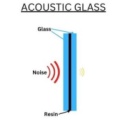
Acoustic laminated glass is laminated safety glass made from:
two (or more) glass panes, and
an acoustic interlayer bonded between them
Standard laminated glass uses an interlayer mainly for safety: if the glass breaks, fragments stick to the interlayer. Acoustic laminated glass does that too—but the interlayer is engineered to reduce noise, especially in common urban frequency ranges.
So, the simple definition is:
Acoustic laminated glass is laminated glass that includes a sound-damping interlayer to help reduce noise passing through windows, doors, and façades.
When sound hits a window, the glass behaves like a thin vibrating plate. The more it vibrates, the more sound energy is transmitted to the indoor side. Acoustic laminated glass reduces that transmission by changing how the glass “moves” and how sound energy travels through the glazing.
Inside acoustic laminated glass, the interlayer is not just a bonding film—it is a damping layer. When the outer pane starts vibrating, the interlayer absorbs part of that vibration energy and converts it into a small amount of heat. This reduces the vibration amplitude, so less sound energy is able to pass through the glass. In practical terms, it helps prevent the window from acting like a loudspeaker that re-radiates outdoor noise into the room.
Real-world noise is made of many frequencies. Traffic, voices, and urban activity often sit in frequency ranges that make speech feel intrusive and “sharp.” Acoustic interlayers are formulated to improve sound reduction in these ranges, where human hearing is especially sensitive. That’s why many projects notice clearer improvement with acoustic laminated glass than with “thicker glass only,” even at similar overall thickness.
The combined effect is a calmer indoor environment—especially for façades near roads, rail lines, airports, or high-activity commercial areas.
Both are laminated glass, but the interlayer purpose changes.
Standard laminated glass: focuses on safety, security, and impact performance
Acoustic laminated glass: provides safety plus enhanced noise reduction performance
In practical project terms, acoustic laminated glass is chosen when noise comfort is an important design goal, not only safety.
Acoustic laminated glass is widely used wherever noise reduction improves comfort or business value.
residential windows in urban or roadside buildings
hotels, especially near transportation corridors
office buildings and meeting rooms
schools and classrooms in busy areas
hospitals and healthcare facilities
curtain walls and building façades
commercial storefront glazing where traffic noise is strong
airports and transit-adjacent developments
In many of these projects, the goal is not absolute silence. The goal is noise reduction that improves daily life and usability.
Acoustic laminated glass is powerful, but performance depends on system design. Here are the main factors that influence results.
Thicker glass can help, but the best performance often comes from the right combination of thickness and interlayer design.
Many effective acoustic glazing solutions use asymmetrical glass thickness (for example, different thickness on each side). This can help reduce resonance and improve performance across a broader frequency range.
The acoustic interlayer is the core difference. Its formulation and thickness affect vibration damping and sound performance.
Acoustic laminated glass is often used as part of a double glazing or triple glazing insulated unit. The cavity and overall build-up can improve sound control and thermal performance together.
This is often overlooked: glass performance is only as strong as the frame and sealing.
If there are gaps in the frame, poor sealing, or weak installation, sound can “leak” around the glass. In many projects, sealing and frame design are just as important as the glass selection.
Project need | How acoustic laminated glass helps | Typical result |
Traffic noise reduction | dampens glass vibration | quieter interior comfort |
Better sleep in urban homes | lowers perceived outside noise | improved residential comfort |
Clearer conversations | reduces echo-like intrusion from outside | better speech comfort |
Hotel guest satisfaction | reduces outside disturbance | fewer noise complaints |
Safety and security | laminated structure holds fragments | improved safety performance |
Selecting the right glass is not only about “acoustic.” It should match your project’s full requirements: safety, thickness limits, frame design, and budget.
Here is a practical selection approach:
Different noise sources have different frequency profiles:
traffic and buses
trains
aircraft
voices and nightlife
industrial equipment
This affects what configuration is most effective.
Projects often define acoustic goals by internal comfort requirements. Even without technical test data, you can define:
“reduce traffic noise noticeably”
“improve bedroom comfort”
“reduce disturbance for hotel rooms”
“enhance meeting room privacy”
Then the technical team can translate this into a suitable glass build-up.
In many cases, acoustic laminated glass is used as part of a double glazing unit to combine:
sound control
thermal performance
condensation control
Laminated glass is often required in:
doors
low-level glazing
railing systems
façade safety zones
Acoustic laminated glass can meet both safety and sound goals at the same time, which is one reason it is attractive.
If the frame leaks air, it leaks sound. A good acoustic glass choice should be paired with:
high-quality seals
correct installation
airtight frame design
Thickness helps, but acoustic interlayers add damping that thickness alone does not provide.
Frame sealing and installation often decide how much noise you still hear.
It reduces sound—it does not create total silence. Real performance depends on the overall building system.
Noise sources differ, and the best glass build-up depends on the application.
At Rider Glass Company Limited, we recommend acoustic laminated glass when projects require both safety and better noise comfort—especially in urban or high-traffic environments. We typically guide customers by first understanding the noise source, window system design, and performance expectations, then recommending a practical glass build-up that balances acoustic improvement with structural requirements and project budget.
For many clients, acoustic laminated glass is one of the most effective “invisible upgrades” a building can make: it maintains the same daylight and modern appearance, but significantly improves comfort.
So, what is acoustic laminated glass? It is laminated safety glass that uses a specialized acoustic interlayer to damp vibration and reduce sound transmission through building glazing. It is commonly used in homes, hotels, offices, healthcare buildings, and façades where outside noise affects comfort. The best results come when the glass configuration, interlayer choice, and window frame sealing work together as one system.
To learn more about Acoustic Laminated Glass options and suitable configurations for your project, you are welcome to contact Rider Glass Company Limited for more information.
Not exactly. Both are laminated glass, but acoustic laminated glass uses a sound-damping interlayer designed to reduce noise more effectively.
No. It reduces noise transmission, but the final result depends on glass build-up, frame sealing, and installation quality.
It is most useful in buildings exposed to traffic, city noise, rail lines, airports, and other external noise sources—especially in bedrooms, hotels, and offices.
Yes. It is often used as part of an insulated glass unit to combine noise reduction with thermal performance and comfort benefits.


