Views: 0 Author: Site Editor Publish Time: 2026-06-24 Origin: Site


Modern architectural designs rely heavily on expansive glass facades. Building professionals face a constant and complex challenge. They must balance stunning aesthetic visions with essential daylighting requirements. They also must adhere to increasingly strict energy compliance standards. Unmanaged sunlight creates severe visual glare. It also drives up interior cooling loads dramatically. Engineers and designers need reliable, cost-effective methods to mitigate these thermal loads. They often need basic strategies before specifying highly complex, multi-layered optical coatings.
Body-tinted options provide an exceptionally solid foundation. They serve as a primary, accessible method for baseline solar mitigation. This article aims to clarify these material selections. We will provide specifiers and buyers with an objective framework. You will learn how to evaluate these products based on light transmittance and solar heat absorption. We will also explore crucial system integration realities. By understanding these core variables, project teams can optimize both visual comfort and energy efficiency.
Performance Trade-offs: Deeper tints reduce Solar Heat Gain Coefficient (SHGC) but proportionally lower Visible Light Transmittance (VLT), requiring careful daylighting calculations.
Thickness Dictates Performance: The thickness of a heat-absorbing glass panel directly alters both its visual color density and its optical/thermal metrics.
Thermal Stress Risks: High heat absorption inherent to tinted glass significantly increases thermal breakage risks, often necessitating heat-strengthening or tempering.
System Integration: Tinted float glass delivers maximum ROI when utilized as the outboard lite in an Insulated Glass Unit (IGU), paired with an inboard Low-E coating.
We must first understand how a heat-absorbing glass panel actually works. Highly reflective metallic coated products manage energy by bouncing it away. Body-tinted options handle energy differently. They absorb solar radiation directly into the glass mass. The material acts like a sponge for solar energy. It takes in the sun's heat instead of reflecting it outward. This fundamentally changes how a building envelope manages thermal loads.
Manufacturers achieve this absorption by altering the raw material mixture. They add precise metal oxides during the float manufacturing process. Raw materials melt at approximately 1500 degrees Celsius. Workers introduce specific elements like iron, cobalt, and selenium into this molten mixture. These metallic oxides mix uniformly. They alter the solar spectrum transmission permanently. Importantly, they do this without compromising the structural integrity of the pane. The base material remains just as physically robust as clear glass variants.
Why does this mechanism matter for modern structures? Baseline solar control remains absolutely critical in commercial facades. High sun exposure causes intense, disruptive glare for occupants. It drastically increases mechanical cooling loads inside the building. Using solar control glass provides an immediate, reliable defense line. It reduces glare effectively. It also provides essential cooling load management. You can achieve baseline comfort without applying fragile surface films.
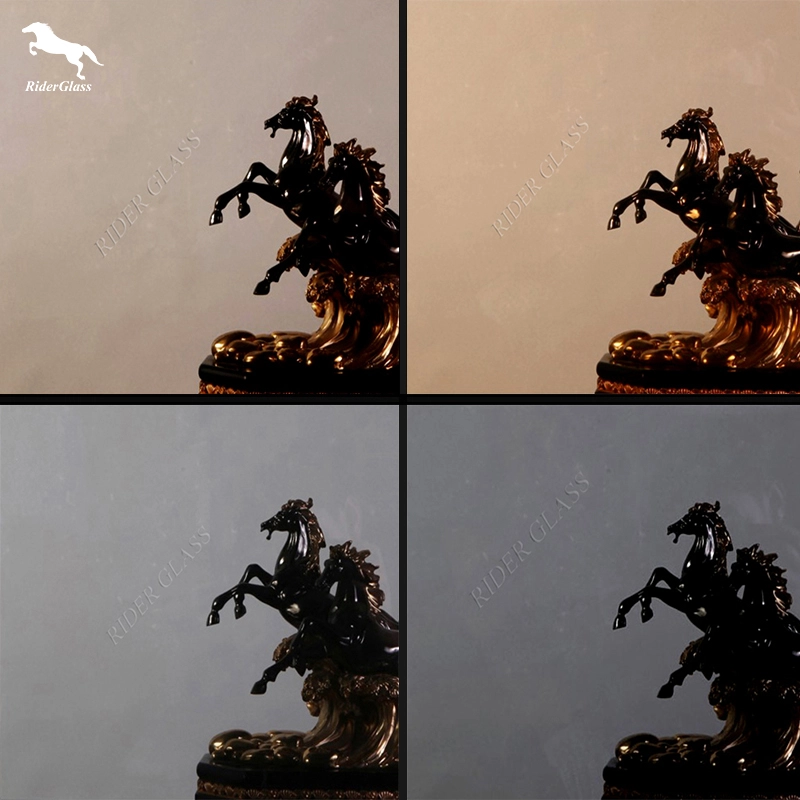
Every color option delivers unique aesthetic finishes and functional results. You must evaluate them carefully against your specific project requirements. Different tints serve entirely different architectural goals.
Bronze and grey tones define many urban skylines today. Bronze offers a warm, earthy architectural finish. Grey provides a muted, neutral, and cool exterior look. Both colors share a distinct performance profile. They feature notably lower Visible Light Transmittance (VLT). They excel at blocking intense sun glare. They also drastically reduce total solar heat gain. However, this high glare control requires caution. You must plan interior lighting setups meticulously. The reduced natural daylight can force occupants to rely heavily on artificial lighting. A common mistake is using heavy grey tints on north-facing elevations, which starves the interior of necessary light.
Blue and green tones present a crisp, modern aesthetic. Architects commonly specify them in high-rise commercial structures. Their performance profile differs significantly from darker bronze or grey tints. They offer much higher VLT. Yet, they still provide measurable solar control. This balance yields a superior Light-to-Solar Gain (LSG) ratio. You achieve greater transparency and better interior daylighting without sacrificing basic thermal protection.
Material thickness acts as a critical evaluation rule. It changes visual and thermal outcomes entirely. A 6mm pane performs fundamentally differently than a 10mm pane. This holds true even if they share the exact same chemical composition. For instance, evaluating bronze grey blue glass requires checking the exact specified gauge.
6mm thickness: Provides higher light transmission. It yields a lighter visual color and allows higher solar heat gain.
8mm thickness: Offers a moderate balance. The color density increases, while heat transmission drops noticeably.
10mm thickness: Delivers much lower light transmission. It creates a deep, saturated visual color and provides maximum heat absorption.
Understanding optical metrics ensures you specify the right material for the climate. Standardized frameworks like those from the National Fenestration Rating Council (NFRC) guide these measurements. Let's break down the core specifications you will encounter.
VLT measures the percentage of visible daylight passing directly through the glazing. Commercial workspaces usually require specific VLT thresholds to maintain occupant well-being. Designers typically target a VLT above 40% for primary working areas. This minimum threshold helps avoid heavy reliance on overhead artificial lighting. It keeps the interior environment bright, open, and productive.
SHGC evaluates the total solar energy transmission. It measures the exact percentage of incident solar radiation entering the building. This metric includes both directly transmitted heat and the absorbed heat radiating inward. Shading Coefficient (SC) serves a similar historical purpose. It compares the material's heat gain against a standard 3mm clear pane. Lower SHGC and SC numbers always indicate better heat-blocking capabilities.
Specifiers use the LSG ratio as the ultimate decision-making metric. You calculate it easily by dividing the VLT by the SHGC. It measures the optical "efficiency" of the tint. A high LSG ratio means you get plenty of visible light with minimal heat transfer. When evaluating colored architectural glass, you should prioritize high LSG ratios for optimal daylighting designs.
Many professionals hold a dangerous misconception regarding U-values. They mistakenly assume dark tints improve winter insulation. This is entirely false. Body-tinted products do not significantly improve the U-value. They do not stop conductive heat loss any better than clear alternatives. A clear 6mm pane and a grey 6mm pane possess almost identical U-values. The tint only manages radiant solar energy, not conductive temperature loss.
Performance Metrics Comparison by Color (Standard 6mm Monolithic Pane) | ||||
Glass Type | Typical VLT | Typical SHGC | Estimated LSG Ratio | Glare Control Level |
|---|---|---|---|---|
Clear (Baseline) | 88% | 0.82 | 1.07 | Poor |
Grey Tint | 45% | 0.58 | 0.77 | High |
Bronze Tint | 47% | 0.60 | 0.78 | High |
Green Tint | 75% | 0.64 | 1.17 | Moderate |
Blue Tint | 60% | 0.55 | 1.09 | Moderate |
Installation methods dictate overall facade performance. You must choose the right system configuration to meet building codes. Material selection alone cannot solve energy challenges.
Monolithic installations involve a single, uninsulated pane. These systems have very narrow use-cases in modern construction. You might specify them in unconditioned spaces like parking garages or transit shelters. They work well for interior decorative partitions. They also suit certain opaque spandrel applications. However, monolithic configurations fail modern energy codes for occupied, conditioned spaces. They provide zero defense against conductive heat transfer.
Commercial building envelopes strictly require an Insulated Glass Unit (IGU) strategy. The standard configuration places the tinted float glass for solar control on the exterior. We call this the outboard lite. The colored surface acts as Surface 1 (outside) and Surface 2 (inside the airspace). You then pair it with a clear inboard lite. This creates a hermetically sealed insulating airspace between them, filled with argon or air.
You achieve maximum envelope performance by adding a Low-E (Low-Emissivity) coating. Manufacturers apply this microscopic metallic layer to Surface 2 or Surface 3 of a tinted IGU. The body-tinted pane absorbs the sun's harsh energy. It heats up significantly. The Low-E coating then acts as a mirror for long-wave radiation. It reflects that absorbed heat back outward. It actively stops the heat from radiating inward into the room. This powerful synergy makes tinted float glass highly effective in extreme climates. You get the aesthetic color on the outside, glare reduction, and robust thermal insulation.
Absorbing immense solar energy comes with distinct physical risks. You must manage these vulnerabilities proactively to prevent catastrophic facade failures.
Thermal breakage represents the primary physical risk. Because the material absorbs heat, it expands. Uneven shading on the facade causes severe temperature differentials across a single pane. Deep mullions, architectural overhangs, or adjacent buildings cast shadows. The sunlit portion heats up rapidly and expands. The shaded portion stays cold and resists expansion. This dynamic creates massive internal edge stress. The pane will crack inevitably if the internal stress exceeds the material's basic edge strength.
You must address this risk early during the specification phase. We highly recommend mandatory thermal stress calculations for every elevation. Facade engineers use specific software to model these risks. They input local climate data, framing shadow patterns, and interior blind proximity. This analysis predicts mathematically whether the specified pane will survive peak summer sun exposures.
Standard annealed glass often lacks the structural strength to withstand severe thermal stress. When calculations indicate high risk, you must upgrade the glass physically.
Heat-strengthened glass: This process provides roughly twice the strength of standard annealed glass. It handles moderate to high thermal stress efficiently without shattering.
Fully tempered glass: This provides four times the mechanical strength. You must specify this when extreme thermal stress pairs with mandatory human safety requirements.
Failing to heat-treat high-absorption glazing remains a frequent industry mistake. It leads directly to costly replacements and safety hazards. Best practices dictate edge seaming or polishing before heat treatment. This removes microscopic flaws where thermal cracks originate. Ensure structural compliance and safety by treating the outboard lite whenever calculations dictate.
Selecting the right solar mitigation strategy requires methodical evaluation. Start your process by defining strict VLT targets first. Once you know exactly how much natural light the space requires, select the corresponding color and thickness. Next, pair that selection with a high-performance Low-E coating within an IGU. This integrated approach ensures you easily hit strict energy codes while maintaining design intent.
Always avoid specifying facade materials based solely on digital computer renderings. Computer monitors cannot replicate true optical glass depth. Digital colors remain flat, backlit, and deceptive.
Your next step is critical for success. Advise your specifiers and procurement teams to request physical material samples immediately. Ensure these samples arrive in the exact specified thickness. You must also request the manufacturer’s center-of-glass performance datasheets. Review these physical and technical assets comprehensively prior to finalizing any procurement orders.
A: No, the color is integral to the glass composition, not a surface film. Manufacturers add specific metal oxides directly into the molten material during the float process. This permanent chemical integration means the color will never fade, peel, blister, or scratch off.
A: Yes, it is highly recommended to combine them in an IGU for optimal solar and thermal performance. The tinted outboard lite absorbs intense solar energy, while the internal Low-E coating reflects that absorbed radiant heat back outside.
A: Thicker glass deepens the tint, lowering both VLT and SHGC, which changes the ratio and alters visual transparency. A 10mm pane contains more colorant mass. It will look substantially darker and transmit far less light than a 6mm pane.
A: Rarely. In most climates, it must be part of an IGU assembly to meet stringent U-value and SHGC building codes. Monolithic installations fail to prevent conductive heat loss, requiring combination with clear inner lites and Low-E coatings.


