Views: 0 Author: Site Editor Publish Time: 2026-06-05 Origin: Site


Thin does not mean fragile. 6.4mm laminated glass — also searched as "1/4 laminated glass," "6.4 lam glass," and "quarter inch safety glass" — is the workhorse of residential safety glazing, appearing in millions of homes, apartments, and commercial interiors worldwide. Its appeal is straightforward: it delivers genuine safety performance, meaningful UV protection, and basic acoustic improvement at a weight and cost point that fits standard residential window frames and lightweight furniture constructions without modification. An experienced laminated glass supplier can help architects and contractors select the right 6.4mm configuration — annealed or tempered, standard or specialty interlayer — based on the specific code requirements of each installation.
At 6.4mm total thickness, this laminate sits at the lighter end of the product range, but it is not a compromise product. When properly specified with quality PVB interlayer, it satisfies the mandatory safety glazing requirements in building codes across North America, Europe, and Asia for doors, sidelites, bathroom windows, and other hazard locations. This article explains exactly what 6.4mm laminated glass is, how it performs, where it is specified by code or best practice, and what differences to watch for when evaluating suppliers.
6.4mm laminated glass is a two-ply composite construction consisting of two annealed or tempered glass panes bonded with a PVB interlayer. The standard configuration is:
3mm annealed glass / 0.4mm PVB / 3mm annealed glass = 6.4mm total (standard annealed)
3mm tempered glass / 0.4mm PVB / 3mm tempered glass = 6.4mm total (tempered variant)
Some suppliers produce 6.4mm laminate from 3.2mm glass plies instead of 3.0mm, resulting in a 6.8mm total thickness. Others use 2.5mm plies for ultra-thin constructions. The 3+0.4+3 configuration is the most widely recognized and code-referenced standard, producing a panel that weighs approximately 15.5 kg/m² — light enough to be handled by a single person and compatible with standard residential hardware.
The interlayer is the defining element of any laminated glass. In 6.4mm laminate, the 0.4mm PVB layer is thin relative to the glass plies, which means the structural and acoustic benefits of the laminate are real but modest compared with thicker constructions. That said, the safety benefit — fragment retention after breakage — is fully present and code-compliant for the applications where 6.4mm is specified.
Buyers encounter 6.4mm laminated glass under several different names. "1/4 inch laminated glass" and "6.4mm laminated glass" describe the same product because one inch (25.4mm) divided by four equals 6.35mm, which rounds to 6.4mm in standard industry practice. "Quarter inch safety glass" is another common search term that points to the same construction.
This dual-naming convention reflects the global nature of glass procurement: North American buyers tend to think in imperial measurements (inches), while metric is the standard in Europe, Asia, and scientific contexts. Both refer to an identical laminate construction, so quotes or specifications under either naming convention should produce the same product if the rest of the specification is equivalent.
The choice between tempered and annealed 6.4mm laminate depends on the installation location and the applicable building code. In most jurisdictions, tempered safety glazing is mandated in specific hazardous locations: within 24 inches (610mm) of the bottom edge of a door, within 18 inches (457mm) of the floor adjacent to a door, adjacent to bathtubs and swimming pools, in windows where the bottom edge is less than 18 inches above the floor, and in fully frameless or minimally framed assemblies. For projects that require heat-treated plies, Rider Glass's tempered glass production delivers consistent surface compression and documented tempering quality across all 6.4mm laminate orders.
Outside these hazard zones, annealed 6.4mm laminate is entirely acceptable and costs less. The key is to verify the applicable code requirement before specifying — mixing up annealed and tempered is one of the most common causes of failed inspections and project delays in glazing installations.
The core benefit of any laminated glass — including 6.4mm — is what happens when it breaks. Standard annealed glass fractures into long, sharp shards that can cause serious lacerations. When either annealed or tempered glass is laminated with PVB, the interlayer holds the fragments in place after breakage. The broken panel stays in the frame, without falling away, and the shards do not scatter into the occupied space. This behavior is not optional in safety glazing applications — it is the defining performance requirement that separates laminated glass from ordinary float glass.
Building codes in the US (IBC Section 2406, IRC Section R308, CPSC 16 CFR 1201), Canada (National Building Code), Europe (EN 12600, CPR), Australia (AS 1288), and most Asian markets mandate laminated glass or tempered glass — or both — in these hazardous locations. A 6.4mm laminate with annealed plies satisfies the laminated glass requirement in fully framed configurations. A tempered 6.4mm laminate satisfies both the lamination and tempering requirements.
The PVB interlayer in 6.4mm laminated glass blocks more than 99% of ultraviolet radiation in the 300–380nm range. This protects interior furnishings, flooring, artwork, and textiles from the cumulative sun damage that causes fading and material degradation. In rooms with significant daylight exposure — living rooms, conservatories, south-facing offices — the UV blocking from 6.4mm laminate makes a measurable difference in the long-term condition of interior materials.
This UV blocking is inherent to the PVB interlayer — it does not require a separate coating or film application, and it will not degrade, scratch, or peel over the life of the glazing. The UV protection is permanent for the lifetime of the laminate, which typically exceeds 20–30 years in well-manufactured products with quality interlayers.
A standard 6.4mm laminate with PVB achieves STC 33–35 dB, compared with approximately 30–31 dB for a single 6mm glass pane of equivalent dimensions. The improvement of 3–5 dB is modest but real. Occupants in rooms with 6.4mm laminate glazing typically notice reduced street noise and traffic sound compared with standard single glazing, even if the improvement is not dramatic.
For projects requiring more significant acoustic performance — locations near airports, railway corridors, or very busy streets — a 6.4mm laminate on the outer pane of a double-glazed unit provides a meaningful upgrade. The mass of the laminate plus the air gap plus the inner glass pane creates an asymmetric acoustic construction that performs better than a symmetric double-glazed unit of equivalent total glass thickness.
At approximately 15.5 kg/m², a 6.4mm laminate is light enough to be installed by two people without mechanical assistance, fits in standard residential window frames designed for 4–6mm glass, and does not impose the structural demands on framing hardware that thicker laminates require. This makes 6.4mm laminate the practical choice for retrofitting safety glazing into existing window and door frames without replacing the framing system.
The light weight also benefits furniture and display applications. Glass tabletops, shelving, and display case panels made from 6.4mm laminate are easy to handle during installation and impose minimal load on cabinetry or wall fixings.
In most residential building codes, the glazing adjacent to doors — sidelites, transoms, and windows within the fall-height zone of a floor — is classified as a safety glazing location. 6.4mm laminated glass, either annealed (where tempered is not required) or tempered (where the code specifically mandates heat-treated glass), satisfies this requirement. The laminate ensures that if the glass is broken, the fragments remain in place rather than falling as dangerous shards into a high-traffic area.
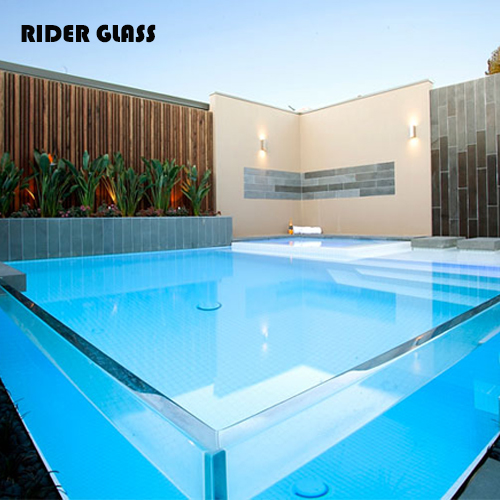
Bathroom windows, shower enclosures, and glazing adjacent to bathtubs and swimming pools are classified as safety glazing locations in virtually all residential building codes. The warm, humid environment in these spaces makes thermal stress fracture more likely in ordinary glass, and the presence of water and wet surfaces amplifies the injury potential if glass does break. 6.4mm tempered laminated glass is the standard specification for these locations: tempered for thermal and mechanical strength, laminated for fragment retention. For projects that extend into architectural water features, Rider Glass's glass swimming pool panels demonstrate how laminated glass achieves both structural transparency and safety in demanding wet-area environments.
Patio doors and large sliding glass doors are major safety glazing surfaces in residential construction. The large glass panels are susceptible to accidental impact — particularly by children and pets — and are a primary entry point for smash-and-grab intruders. 6.4mm tempered laminated glass addresses both concerns: the tempered plies resist accidental impact, and the laminate prevents the glass from shattering into a large open hole if it does break.
For ground-floor patio doors where security is a primary concern, some architects specify 8.8mm or 11.5mm laminate for the additional thickness and resistance. However, for upper-floor installations or in residential communities with controlled access, 6.4mm tempered laminate provides adequate safety and security at a lower cost and with lighter framing requirements.
Glass tabletops, shelves, and display surfaces in residential settings benefit from lamination for safety reasons. A standard glass tabletop, when broken, can shatter into sharp shards that scatter across the surrounding floor — a particular hazard in homes with children. A 6.4mm laminate eliminates this hazard: if the glass cracks, the fragments remain bonded to the interlayer, and the tabletop can be replaced safely without an emergency cleanup of dangerous shards.
For dining tables and other frequently used surfaces, 6.4mm laminate with polished edges is the most common specification. The laminate is thin enough to use standard glass hardware (standoffs, clips, channel systems) without modification, and the polished edges provide a safe, comfortable touch surface.
Small residential skylights and roof windows are frequently glazed with 6.4mm laminated glass in many international markets. The laminate ensures that if the skylight glass is broken by wind debris, maintenance foot traffic, or extreme weather, the fragments are retained and do not fall into the occupied space below. In overhead glazing applications, tempered 6.4mm laminate is typically required by code, and SGP interlayer is preferred where available for its superior post-breakage stiffness.
Commercial interiors use 6.4mm laminated glass for office partitions, meeting room walls, elevator lobby infills, and corridor glazing. The safety benefit — fragment retention if the glass is broken — protects building occupants, and the UV blocking protects interior furnishings and equipment from sun damage through large area glazing. In offices with south or west-facing glazing, the UV protection from 6.4mm laminate can meaningfully extend the life of ergonomic seating, carpets, and artwork.
Retail environments with interior display cases and store-front sidelites specify 6.4mm laminated glass for the safety and UV protection combination. The laminate keeps merchandise protected if the display case is accidentally impacted, and the UV blocking preserves the color and condition of displayed products, particularly for textiles, leather goods, and artwork that are sensitive to light exposure.
In some commercial applications — retail environments, hospitality settings, lower-rise commercial buildings — 6.4mm tempered laminated glass is used in handrail infill panels and low-level glazing where the glazing is within reach of occupants. The tempered plies provide strength, and the laminate retains fragments if the glass is broken. Specific design requirements vary by jurisdiction, so confirm with the applicable building code and a qualified structural engineer.
Understanding where 6.4mm sits relative to other commonly available laminated glass thicknesses helps with specification decisions:
Thickness | Construction | Weight (kg/m²) | STC (dB) | Typical Use |
|---|---|---|---|---|
4.4mm lam. | 2+0.4+2 | 10.5 | 30–32 | Picture framing, inserts |
6.4mm lam. | 3+0.4+3 | 15.5 | 33–35 | Res. windows, furniture, doors |
8.8mm lam. | 4+0.8+4 | 21.5 | 35–37 | Balustrades, commercial fenestration |
11.5mm lam. | 5+1.5+5 | 27.5 | 36–38 | Commercial facades, overhead |
13.5mm lam. | 6+1.5+6 | 32.5 | 37–40 | Commercial balustrades, facades |
17.5mm lam. | 8+1.5+8 | 43.5 | 38–42 | High-security, soundproofing |
The 6.4mm laminate sits at the lightweight end of the scale, with the lowest weight and the most modest acoustic performance. That is by design: it is optimized for the residential applications where it is most used, where weight and cost matter more than maximum acoustic isolation or structural stiffness. For applications that require more — higher security, better acoustic performance, greater spanning capability — thicker laminate options are available, but they carry proportionally higher weight and cost.
This is the most important specification decision for 6.4mm laminate. Before getting quotes, identify the exact locations where the glass will be installed and the applicable building code requirements. If the code mandates tempered glass for your application, an annealed laminate quote is not an acceptable substitute — even if the supplier offers it at a lower price. Confirm the tempering requirement in writing before placing an order.
Not all PVB interlayers are equivalent. Premium brands (Eastman Trosifol, Kuraray, Sekisui) provide consistent adhesion, UV stability, and optical clarity. Generic or unbranded interlayers may yellow, delaminate, or lose adhesion prematurely, particularly in UV-exposed or humid environments. Request the interlayer data sheet and verify the brand, thickness tolerance, and UV transmission specification. Rider Glass sources from established international interlayer suppliers and can provide technical data sheets and warranty documentation for all standard and specialty interlayers used in 6.4mm laminate production.
Measure delivered panels with calipers to verify that the actual thickness matches the specification. EN 14449 permits ±0.2mm deviation per glass ply and ±0.1mm for the interlayer, giving a cumulative tolerance range of approximately ±0.5mm. Significant deviation outside this range is grounds for rejection.
For furniture and display applications where edges are visible or touchable, confirm the edge finish. Standard as-cut edges are adequate for concealed glazing; polished or arrissed edges are required for exposed installations. Polishing adds cost ($5–15 per linear meter) but is essential for furniture applications where sharp edges would be a safety hazard.
Most manufacturers have minimum order quantities (MOQs) for custom 6.4mm laminated glass orders — typically 20–50 square meters for standard configurations. Below this threshold, a per-panel setup surcharge typically applies. For very small orders (single panels or a few square meters), domestic suppliers may be more cost-effective than international sourcing, even if the unit price is higher, because the international freight cost becomes disproportionate on small volumes.
Rider Glass produces 6.4mm laminated glass in both annealed and tempered configurations, with standard PVB, acoustic PVB, and SGP interlayer options. The product is manufactured on automated lamination lines with strict quality control at each process stage: glass cutting, washing and deaerating, interlayer alignment, autoclave lamination, and final inspection.
The company stocks common 6.4mm laminate configurations in both annealed and tempered versions, enabling short lead times on standard orders. For specialty interlayers — tinted PVB, acoustic PVB, low-iron glass substrate — Rider Glass maintains inventory of key interlayer grades and can produce custom configurations without lengthy procurement delays.
Competitor A may offer lower base prices for 6.4mm laminate but uses unbranded or generic PVB that lacks documented long-term durability. Competitor B may offer quality interlayers but has tempering furnace limitations that restrict the maximum panel size they can handle, forcing larger orders to be split into smaller panels with more joints. Rider Glass's combination of quality interlayer sourcing and full-range tempering capability addresses both constraints.
For international buyers, Rider Glass manages export packaging (ISPM 15 compliant timber crating), documentation (certificates of origin, quality reports, packing lists), and logistics coordination from factory to project site. The freight cost proportion on 6.4mm laminate — which is lighter than thicker laminates — makes it one of the most cost-effective laminated glass products for international shipping, and Rider Glass leverages this in competitive pricing for export orders.
A: Yes. One quarter of an inch equals 6.35mm, rounded to 6.4mm in standard industry practice. Both terms describe the same two-ply laminate construction (3mm glass + 0.4mm interlayer + 3mm glass). You will see both "6.4mm laminated glass" and "1/4 laminated glass" used interchangeably in procurement contexts, and quotes under either description should be equivalent when the rest of the specification is the same.
A: Yes. Standard PVB interlayers block more than 99% of UV radiation in the 300–380nm range. This provides meaningful protection for interior furnishings, flooring, artwork, and merchandise from sun-induced fading and degradation. The UV blocking is inherent to the PVB interlayer and does not require separate treatment or maintenance over the life of the laminate.
A: Standard 6.4mm laminate with PVB achieves STC 33–35 dB, approximately 3–5 dB better than a single 6mm glass pane. For comparison, a double-glazed unit with two 4mm glass panes typically achieves STC 29–31 dB. The laminate provides modest acoustic improvement over single glazing; for significant acoustic performance upgrades, thicker laminates or double-glazed assemblies with laminated panes are needed.
A: 6.4mm laminated glass is commonly used in residential entry door sidelites and transom windows. For the glass panel within the door itself (door lite), thicker laminates like 8.8mm or 11.5mm are more commonly specified for better stiffness and security. Verify the applicable building code requirement for your jurisdiction before specifying, as tempered glass may be mandated in door glazing within specific distances from the door bottom or floor level.
A: Tempered 6.4mm laminate uses heat-treated glass plies that are approximately four times stronger in flexural strength than annealed plies. Tempered glass breaks into small granules rather than sharp shards. Building codes mandate tempered safety glazing in specific hazardous locations (near doors, floors, bathtubs, pools). Annealed 6.4mm laminate is appropriate in fully framed installations where tempered glass is not specifically required by code. Both versions retain fragments when broken due to the PVB interlayer.
A: Small residential skylights are sometimes glazed with 6.4mm tempered laminate in some markets, but it is at the lighter end of what most codes consider adequate for overhead applications. For overhead glazing, thicker laminates (8.8mm or above) with tempered plies and SGP interlayer are more commonly specified. Verify the applicable code requirements for your specific overhead glazing application before specifying 6.4mm laminate.
A: Well-manufactured 6.4mm laminated glass with quality PVB interlayer typically lasts 25–35 years or more in typical building installations. The limiting factors are interlayer durability (particularly in UV-exposed or humid environments) and edge seal integrity. Premium interlayers from established brands carry 10–15 year warranties against delamination and discoloration. Poor-quality interlayers may yellow or lose adhesion within 5–8 years, particularly in south-facing or coastal installations.
6.4mm laminated glass is the entry point to genuine safety glazing performance in residential and light commercial applications. Its lightweight, cost-effective construction delivers the fragment retention, UV blocking, and acoustic improvement that most standard residential window and door applications require — without the weight, complexity, and cost of thicker laminate options.
The specification decision — annealed or tempered, standard PVB or specialty interlayer — should be driven by the applicable building code requirements and the specific performance demands of each installation location. For hazard locations mandating tempered safety glass, the tempered version is non-negotiable. For other locations, annealed 6.4mm laminate with quality PVB delivers safety benefits at a lower cost. Rider Glass produces 6.4mm laminated glass in both annealed and tempered configurations, stocks standard and specialty interlayers, and manages full export documentation and logistics for international residential and commercial projects.


