Views: 0 Author: Site Editor Publish Time: 2026-05-24 Origin: Site


Designing an outdoor oasis brings high stakes. You must perfectly balance beautiful aesthetics against strict safety liabilities. A glass swimming pool barrier looks stunning, but it carries immense responsibility. A failed panel can lead to tragic consequences.
Property owners and installation contractors face a difficult decision at the final project phase. They know building codes demand certified safety materials to prevent fatal accidents. However, they must choose between two fundamentally different structural behaviors. They must evaluate the physical loads, environmental resilience, and upfront price points of different safety panels.
This guide provides a detailed, evidence-based breakdown. We show exactly how both materials perform under severe impact, harsh weathering, and long-term structural stress. You will learn the exact mechanics behind their specific failure modes. Ultimately, these practical insights will help you confidently finalize your precise enclosure specifications.
Performance difference: Tempered glass is engineered for "safe breakage" (shattering into blunt pebbles), while laminated glass is engineered for "containment" (cracking but remaining intact as a physical barrier).
Industry standard: 1/2″ (12mm) tempered glass is the baseline for most residential glass pool fences due to its high tensile strength and cost-efficiency.
Upgraded protection: Laminated glass is required for zero-fallout zones, commercial spaces, and high-wind (hurricane) regions, though it carries a heavier structural load.
Implementation risk: Neither glass type can be cut or drilled after manufacturing; exact pre-fabrication site measurements are non-negotiable.
All compliant enclosures must use regulated safety materials. Certifications like ANSI Z97.1 and CPSC 16 CFR 1201 dictate strict performance baselines. They ensure panels survive specific pendulum impact tests. However, the exact category of safety certification determines how the panel ultimately fails. You must understand this fundamental difference.
Manufacturers create this product through extreme thermal shock. They heat standard annealed glass above 620°C (1,148°F) inside a specialized furnace. They then rapidly cool it using high-pressure air drafts. This rapid quenching process creates intense internal surface compression.
This process yields a highly resilient product. Real-world testing proves it is four to five times stronger than standard options. We refer to this common material as tempered glass. It resists heavy blunt force beautifully. However, it operates on an all-or-nothing structural principle.
When physical limits finally breach, it shatters instantly. The entire panel explodes into small, blunt pebbles. It leaves no jagged shards behind. These tiny granules rarely cause severe physical lacerations. This characteristic earns it the "safe breakage" industry classification.
Factories construct this alternative like a transparent sandwich. They permanently bond two or more panels around a central polymeric core. This interlayer usually consists of Polyvinyl Butyral (PVB) or SentryGlas Plus (SGP). The manufacturing process requires immense heat and pressure inside an autoclave chamber.
Impact behavior differs drastically from single-pane options. When struck by heavy force, the outer glass layers crack. They fracture into complex spider-web patterns. However, the broken pieces adhere tightly to the inner polymer film. They do not fall to the ground.
The physical barrier remains standing securely. This containment mechanism prevents immediate security gaps. It stops toddlers or pets from wandering into the water through a broken section. It sacrifices aesthetic clarity after an impact to preserve the physical boundary.
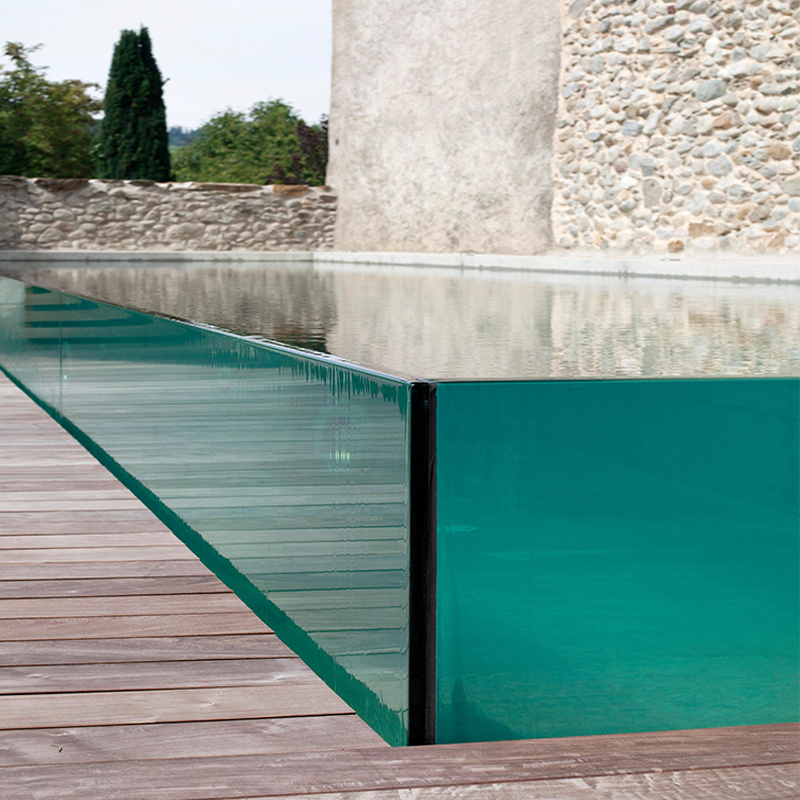
A standard 1/2-inch (12mm) tempered glass pool enclosure dominates the modern market. It serves as the default specification for over eighty percent of residential backyard projects. Homeowners love it because it balances reliable safety against accessible upfront budgets.
This material thrives in typical backyard environments. It offers several specific engineering advantages for ground-level installations.
Tensile Strength & Wind Load: It resists severe bending forces. The internal compression handles heavy environmental pressure efficiently. You can lean against it without fear of snapping.
Aesthetic Clarity: It looks perfect in premium frameless systems. The exposed, polished edges remain pristine over time. They lack internal polymer layers, preventing cloudy edge degradation.
Budget Efficiency: It requires lower raw material investments. The single-pane design weighs less. This reduces cross-country shipping rates and simplifies the physical installation process.
You must acknowledge the structural compromises of this material. Even the strongest panels carry specific vulnerabilities. You need to plan for these rare scenarios.
The Containment Gap: A shattered panel disappears entirely. Imagine a lawnmower throwing a small rock into the barrier. The panel shatters safely, but it leaves an empty space. You leave the water temporarily unprotected until a replacement arrives.
Spontaneous Breakage: A rare but documented risk exists. Microscopic nickel sulfide (NiS) inclusions occasionally enter the raw mixture during manufacturing. These tiny particles expand slowly over months or years. They can cause sudden shattering without any external impact. Installers can request "heat-soaked" panels to identify these defects before shipment, reducing this risk significantly.
Sometimes project requirements push beyond standard limits. You might face elevated security mandates or strict municipal liability rules. Extreme weather zones also dictate necessary upgrades. In these scenarios, a laminated glass fence becomes mandatory.
This heavy-duty setup provides unparalleled peace of mind. It solves highly specific environmental challenges.
Barrier Retention: It offers crucial zero-fallout protection. A broken panel never collapses. Children and pets still cannot access the water after a severe accident.
Environmental Shielding: The polymer interlayer blocks up to 97% of harmful UV rays. This drastically slows the fading of nearby outdoor deck furniture. Furthermore, the multi-layer structure dampens ambient noise significantly better than single-pane panels. It blocks out loud neighborhood traffic.
Hurricane Compliance: Upgrading the core to an SGP (SentryGlas Plus) interlayer changes everything. SGP feels rigid and structural. It meets incredibly strict coastal high-wind building codes. It resists flying debris during severe tropical storms.
Upgrading to multi-layer panels introduces new maintenance challenges. You must monitor specific wear-and-tear issues unique to layered construction.
Delamination Risk: Constant moisture poses a major threat. Capillary action can draw standing pool water into the exposed edges. Prolonged exposure to harsh pool chemicals exacerbates this process. The interlayer eventually degrades and separates from the outer panes. This causes an ugly, cloudy appearance along the perimeter.
Weight & Hardware Stress: Layered panels weigh substantially more. Standard mounting hardware will fail under this immense load. Installation crews must use heavy-duty spigots. They require robust structural framing. This prevents dangerous sagging over time.
You need a clear comparison to make a final engineering decision. The table below outlines how each material behaves across different performance categories. Review these outcomes carefully before ordering materials.
Performance Feature | Tempered Panels | Laminated Panels |
|---|---|---|
Impact Resilience | Resists harder blunt impacts without cracking due to high surface compression. | Cracks easier under blunt force, but physically retains all broken shards. |
System Compatibility | Ideal for heavy frameless systems. Edges remain fully exposed without risk. | Performs best in framed or semi-frameless systems. Frames protect vulnerable edges. |
Edge Clarity | Crystal clear. Fully polished perimeters look pristine permanently. | Slight visible line where the polymer film meets the outer layers. |
Maintenance Needs | Requires simple non-abrasive soapy water cleaning. Zero edge maintenance. | Requires routine inspection of panel edges and heavy-duty mounting clamps. |
Failure Mode | Shatters entirely into harmless granules. Leaves a physical security gap. | Cracks heavily into a spider-web pattern. Maintains the solid physical barrier. |
High-end commercial projects often refuse to compromise. They demand the absolute best of both engineering worlds. Manufacturers solve this by producing "Tempered Laminated Glass." They take two fully toughened panels and bond them around an SGP core.
This hybrid setup combines extreme tensile strength with guaranteed containment. It resists heavy impact effortlessly. If a massive force finally breaks it, the SGP core holds the heavy, shattered granules in place. Builders mandate this specific combination for luxury commercial properties. You will see it on high-rise rooftop pools and premium high-traffic resort decks. It commands the highest price point but delivers unmatched liability protection.
Procuring raw materials represents only half the battle. You must perfectly execute the installation phase. Mistakes during the measuring phase will ruin the entire project budget.
You cannot modify either material on-site. Manufacturers cannot cut, drill, or trim these panels after the toughening or bonding process. Any attempt to modify the edges will instantly shatter or delaminate the product.
Exact pre-fabrication site measurements remain strictly non-negotiable. Hole placements for heavy gate hinges must be perfectly accurate. Gradient calculations for sloped concrete decks require extreme precision. You must verify every single millimeter before you finalize the factory order.
Follow this logical framework to finalize your glass pool fence purchase. Your specific environment dictates the correct engineering choice.
Choose Tempered Panels if: You install a standard residential ground-level setup. You prioritize a pristine, invisible frameless look. You want to optimize the overall project budget safely.
Choose Laminated Panels if: Your water feature sits on a raised balcony or steep drop-off. You live in a designated coastal hurricane zone. You require a guaranteed physical barrier even immediately after a severe accident.
Hardware Consideration: Pay close attention to mounting components. Demand powder-coated aluminum or marine-grade stainless steel (316L). Standard 304 stainless steel will rust quickly near salt-water systems. Rust compromises the mounting points and threatens the entire structural system.
Selecting the right barrier material requires careful risk assessment. Both materials offer code-compliant safety features. However, they solve entirely different engineering problems. They handle physical failure in distinct ways.
Single-pane toughened panels mitigate injury from the material itself. They shatter harmlessly to protect bystanders from lacerations. Conversely, multi-layer panels mitigate injury by maintaining a persistent physical barrier. They stop secondary accidents like accidental drowning after an impact event.
Always consult your local municipal building codes before ordering. Many coastal or elevated regions mandate multi-layer upgrades by law. We highly advise requesting formal engineering specifications from your chosen installation contractor. Verify panel thickness and hardware load ratings early. Review your unique site exposure carefully to select the exact right system for your property.
A: No. Building codes strictly prohibit regular annealed glass. You must use certified safety-rated materials. Standard glass shatters into massive, deadly shards upon impact. Using it creates severe fatal laceration risks and violates every municipal safety regulation.
A: Standard frameless residential systems typically require 1/2 inch (12mm) thickness. This handles normal wind loads efficiently. Laminated panel thickness varies significantly based on the chosen interlayer and the specific extreme wind load requirements of your geographic region.
A: It can develop cloudiness if edge-seal degradation occurs. Industry professionals call this delamination. Poor installation or constant exposure to standing water usually causes it. Using framed mounting systems helps mitigate this risk by fully protecting the vulnerable perimeter edges.
A: Yes, although the event remains extremely rare. Microscopic nickel sulfide inclusions trapped during manufacturing can slowly expand, causing sudden failure. Additionally, invisible edge damage sustained during the initial installation process can trigger delayed, spontaneous shattering months later.


